
A student visa interview is short, and the officer is not testing ten unrelated things. Behind the questions sit five concerns: whether your study plan is clear, whether your funding is credible, whether your ties pull you home, whether your answers agree with each other and with your file, and whether you can answer plainly under a little pressure. This guide walks through the ten questions our Visa Interview Simulator practices, what the officer is listening for in each one, and the answer shapes that hurt.
One honesty note before the questions. These are the commonly reported student visa interview questions that prep guides discuss, not official consulate questions. The simulator is not affiliated with any embassy, consulate, or government, and no practice tool can guarantee a visa outcome. Each question below exists in three wordings, a US F-1 track, a UK credibility track, and a general track. The US wording heads each section; where the UK or general version changes what matters, that difference is flagged in place.
Study plan clarity
1. Why do you want to study in the United States?
The officer is listening for a study reason, not a travel reason. The strong answer in the simulator names the field first, then one specific strength of this country's programs in that field, then one thing home universities do not offer: flood modeling, in the simulator's example, with the research groups working in it named. An answer like that answers the next two questions before they are asked. What hurts: the childhood dream answer, heavy on lifestyle, cities, and opportunities, light on the course. Officers hear attachment to the country rather than to the course, and attachment is the opposite of what this interview tests. The weakest shape in the bank is blunter: any developed country would do, and an agent suggested this one because the visa process is simpler. That tells the officer there is no study plan at all, and that someone else is driving the application.
2. Why did you choose this university?
Here the officer wants a researched choice, not a famous name. The strong answer compares programs in detail and names two things this exact course offers that the alternatives did not, a lab, a capstone, a module list that matches a thesis plan, and adds that it fits the budget the family can actually pay. If an agent shortlisted the university, the practice line is to say what you checked yourself. What hurts: rankings alone, which sound memorized, and officers hear that answer many times a day. Saying your consultant recommended it and prepared the application is worse, because now the officer doubts the plan is yours. Worst is the first-offer answer: the university was simply the first to say yes, so there was no comparison and no plan for the officer to test.
Funding credibility
3. Who is sponsoring your studies, and what do they do?
Funding credibility sounds like a named sponsor, a real occupation, and money that has visibly been there for a while. The strong answer names the sponsor, what they do, where the money sits, and since when. On the UK track the question adds a clause, how long has the money been held in your account, and the strong UK answer states that the full amount has been held for well over the required 28 consecutive days, with statements to show it. If a loan is part of the funding, the practice line is to say what is already sanctioned, not what is promised. What hurts: a loan approved in principle plus an uncle who has promised to help. Arranged in the future is not funded today, and unsure is a bad place to leave a funding answer. Planning to cover the fees with part-time work after you arrive fails outright: student visas are granted on funds you already have, not wages you hope to earn.
4. What is the total cost of your program, and how much of it is tuition?
Know two numbers cold before the interview: your yearly tuition and your total first-year cost, split into tuition and living costs, and be able to say who covers year two. The strong answer gives exact figures and matches them to a sponsor who can cover them, which is what makes the officer believe the person answering filled in the form. Close but vague, around 40,000 including everything, exact figure forgotten, invites the follow-up questions you least want. What hurts: quoting roughly half your real cost and explaining that your agent prepared the financial documents, which casts doubt on the documents and on your ownership of the application in one breath. The other failure is confidence without figures: the cost does not matter, my family will pay whatever it takes. Officers trust figures, not confidence. The UK wording asks for tuition plus the maintenance amount you need to show; the discipline is the same.
Home ties and intent
5. What are your plans after you finish your studies?
A plan beats a promise. The strong US answer names a role, a named employer or family business, and the specific thing this degree lets you do there: returning to lead the technical side of the family engineering firm, in the simulator's example. That is home ties told as a story the officer can picture. The thinner version, probably come back and look for a job, has the right direction and no weight: no employer, no role, nothing the officer can hold on to. On the US track, mentioning practical training after the degree is not itself the problem; it is a legal part of the F-1 path. Leaving your long-term intent open afterward is. The UK track flips one part of this. The strong UK answer is honest about using the Graduate visa for up to two years of UK work experience in the field, then returning home. Credibility interviews reward that honesty, because pretending the Graduate route does not exist sounds rehearsed. What fails on both tracks is naming permanent settlement as the real goal. On a non-immigrant student visa, that answer settles the officer's central question for them, in the wrong direction.
6. Why can you not study this course in your home country?
Compare curricula, not countries. The strong answer picks two concrete gaps in the home version of the course, a lab that does not exist, a capstone that is missing, modules absent from the home curriculum, and names them. The generic answer, the quality and exposure are better there, is probably true and completely unprovable, and every applicant says it. What hurts: running down your own country, saying its degrees have no value and everyone who can leaves. That argues your ties at home are weak and your plan is to leave, not to study. The bank's zero-score answer removes the last reason to grant a temporary study visa: it does not matter, since I am not planning to go back anyway.
What the database is
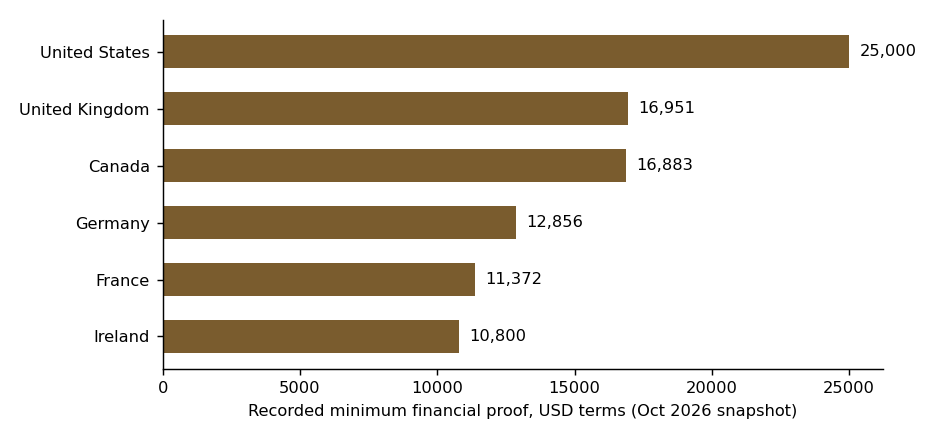
Every guide on this site draws on one dataset: our student visa database, 102 destination records at an October 2026 snapshot. Of the 102 records, 100 state a minimum financial proof figure, recorded in USD terms so destinations can be compared on one scale. This page is the index to that data, modeled on the hub structure of InternationalStudent's F-1 visa hub.
The six highest named records
Two North American records top the table, and the gap from second to third is 68 dollars.
| Destination | Recorded minimum proof (USD) | How the destination collects it |
|---|---|---|
| United States | $25,000 | Shown as available funds on the I-20 |
| United Kingdom | $16,951 | Funds held for 28 consecutive days |
| Canada | $16,883 | CAD 22,895 placed in a GIC, separate from tuition |
| Germany | $12,856 | 11,208 euro in a blocked account |
| France | $11,372 | Recorded in USD terms in the database |
| Ireland | $10,800 | Recorded in USD terms in the database |
The regional picture
Europe's median across 39 records is $9,800, which makes the UK an outlier inside its own region: at $16,951 it asks roughly 73 percent more than the typical European destination. Africa and Latin America record medians of $3,000. Only North America records higher figures than the UK, which is why the same student can look well funded in one application and short in another without spending a rupee in between. The per-country detail sits in the guides: proof of funds by country and the requirements checklist.
What the database does not claim
A recorded minimum is a floor, not a budget. Tuition sits on top of it (Canada states the living figure separately from tuition on purpose), fees sit outside it, and the figures are the rules as recorded at the snapshot, not a promise they have not moved since. Where a destination's guide on this site disagrees with a number you were quoted elsewhere, the guide names its source and date so you can check the current rule before you commit money.
●Work with me
Practice your visa interview before it counts
A 45-minute mock interview with straight feedback on your answers, your documents, and your weak spots.
Want a mock visa interview? Tell me your country, visa type, and interview date.